传送门
题意
水题,主要是拿来试试模板
题解
F[i]=f[i-1]-f[i-2]
1
2
3
4
5
6
7
8
9
10
11
12
13
14
15
16
17
18
19
20
21
22
23
24
25
26
27
28
29
30
31
32
33
34
35
36
37
38
39
40
41
42
43
44
45
46
47
48
49
50
51
52
53
54
55
56
57
58
59
60
61
62
63
64
65
66
67
68
69
70
71
using namespace std ;typedef long long ll;typedef unsigned long long ull;#define pp pair<int,int> const ll mod=1e9 +7 ;const int maxn=1e6 +50 ;const ll inf=0x3f3f3f3f3f3f3f3f LL;int (int a,int b) while (b){int t=a%b;a=b;b=t;}return a;}int lcm (int a,int b) return a*b/gcd(a,b);}struct Matrix { ll mat[5 ][5 ]; int n; Matrix(){} Matrix(int _n){ n=_n; for (int i=0 ;i<n;i++) for (int j=0 ;j<n;j++) mat[i][j]=0 ; } Matrix operator *(const Matrix &b)const { Matrix ret=Matrix(n); for (int i=0 ;i<n;i++){ for (int k=0 ;k<n;k++){ if (mat[i][k]) for (int j=0 ;j<n;j++){ ret.mat[i][j]+=(mat[i][k]*b.mat[k][j]+mod)%mod; ret.mat[i][j]+=mod; ret.mat[i][j]%=mod; } } } return ret; } ull pow_m (ull a,int n) { ull ret=1 ,tmp=a; while (n){ if (n&1 )ret*=tmp; tmp*=tmp; n>>=1 ; } return ret; } Matrix pow_M (Matrix a,ll n) { Matrix ret=Matrix(a.n); for (int i=0 ;i<a.n;i++)ret.mat[i][i]=1 ; Matrix tmp=a; while (n){ if (n&1 )ret=ret*tmp; tmp=tmp*tmp; n>>=1 ; } return ret; } }; int main () std ::ios::sync_with_stdio(false ); std ::cin .tie(0 ); std ::cout .tie(0 ); ll x,y,n; cin >>x>>y>>n; Matrix a=Matrix(2 ); a.mat[0 ][0 ]=1 ;a.mat[0 ][1 ]=-1 ; a.mat[1 ][0 ]=1 ,a.mat[1 ][1 ]=0 ; if (n==1 ){cout <<(x+mod)%mod<<endl ;return 0 ;} if (n==2 ){cout <<(y+mod)%mod<<endl ;return 0 ;} a=a.pow_M(a,n-2 ); cout <<((a.mat[0 ][0 ]*y+a.mat[0 ][1 ]*x)%mod+mod)%mod; return 0 ; }
1
2
3
4
5
6
7
8
9
10
11
12
13
14
15
16
17
18
19
20
21
22
23
24
25
26
27
28
29
30
31
32
33
34
35
36
37
38
39
40
41
42
43
44
45
46
47
48
using namespace std ;typedef long long ll;#define pp pair<int,int> const ll mod=1e9 +7 ;const int maxn=1e6 +50 ;const ll inf=0x3f3f3f3f3f3f3f3f LL;int (int a,int b) while (b){int t=a%b;a=b;b=t;}return a;}int lcm (int a,int b) return a*b/gcd(a,b);}ll x,y; typedef vector <ll>vec;typedef vector <vec>mat;mat mul (mat& A,mat &B) { mat C(A.size(),vec(B[0].size())); for (int i=0 ;i<A.size();i++) for (int k=0 ;k<B.size();k++) if (A[i][k]) for (int j=0 ;j<B[0 ].size();j++) C[i][j]=(C[i][j]+A[i][k]*B[k][j]%mod+mod)%mod; return C; } mat Pow (mat A,ll n) { mat B(A.size(),vec(A.size())); for (int i=0 ;i<A.size();i++)B[i][i]=1 ; for (;n;n>>=1 ,A=mul(A,A)) if (n&1 )B=mul(B,A); return B; } int main () std ::ios::sync_with_stdio(false ); std ::cin .tie(0 ); std ::cout .tie(0 ); cin >>x>>y; ll n; cin >>n; if (n==1 ){ cout <<(x+mod)%mod<<endl ;return 0 ; } else if (n==2 ){ cout <<(y+mod)%mod<<endl ;return 0 ; } mat a(2,vec(2)); a[0 ][0 ]=1 ;a[0 ][1 ]=-1 ;a[1 ][0 ]=1 ;a[1 ][1 ]=0 ; a=Pow(a,n-2 ); cout <<(a[0 ][0 ]*y%mod+a[0 ][1 ]*x%mod+mod+mod)%mod<<endl ; return 0 ; }
题意
给出矩阵的第0行(0,233,2333,23333,…)和第0列a1,a2,…an(n<=10,m<=10^9),给出式子:
题解
假设要求A[a]【b]则
相当于上图,红色部分为绿色部分之和,而顶上的绿色部分很好求 左边的部分就是前一列的(1-n)的和
所以我们只要知道第一列和第一行就能推出任意列@
构造上图的中间矩阵,因为第0列到第一列不符合 所以手动求出第一列的答案,然后再求出中间矩阵的m-1次方 和第一列相乘就是答案了
1
2
3
4
5
6
7
8
9
10
11
12
13
14
15
16
17
18
19
20
21
22
23
24
25
26
27
28
29
30
31
32
33
34
35
36
37
38
39
40
41
42
43
44
45
46
47
48
49
50
51
52
53
54
55
56
57
58
59
60
61
62
63
64
65
66
67
68
69
70
71
72
73
74
75
76
77
78
79
80
81
82
83
84
85
86
87
88
89
90
91
92
93
94
95
96
97
98
99
100
101
102
103
using namespace std ;typedef long long ll;typedef unsigned long long ull;#define pp pair<int,int> const ll mod=1e7 +7 ;const int maxn=1e6 +50 ;const ll inf=0x3f3f3f3f3f3f3f3f LL;int (int a,int b) while (b){int t=a%b;a=b;b=t;}return a;}int lcm (int a,int b) return a*b/gcd(a,b);}struct Matrix { ll mat[15 ][15 ]; int n; Matrix(){} Matrix(int _n){ n=_n; for (int i=0 ;i<n;i++) for (int j=0 ;j<n;j++) mat[i][j]=0 ; } Matrix operator *(const Matrix &b)const { Matrix ret=Matrix(n); for (int i=0 ;i<n;i++){ for (int k=0 ;k<n;k++){ if (mat[i][k]) for (int j=0 ;j<n;j++){ ret.mat[i][j]+=(mat[i][k]*b.mat[k][j]+mod)%mod; ret.mat[i][j]+=mod; ret.mat[i][j]%=mod; } } } return ret; } ull pow_m (ull a,int n) { ull ret=1 ,tmp=a; while (n){ if (n&1 )ret*=tmp; tmp*=tmp; n>>=1 ; } return ret; } Matrix pow_M (Matrix a,ll n) { Matrix ret=Matrix(a.n); for (int i=0 ;i<a.n;i++)ret.mat[i][i]=1 ; Matrix tmp=a; while (n){ if (n&1 )ret=ret*tmp; tmp=tmp*tmp; n>>=1 ; } return ret; } }; ll num[20 ]; ll sum[20 ]; int main () std ::ios::sync_with_stdio(false ); std ::cin .tie(0 ); std ::cout .tie(0 ); ll n,m; while (cin >>n>>m){ Matrix a=Matrix(n+2 ); num[0 ]=0 ; for (int i=1 ;i<=n;i++)cin >>num[i]; sum[0 ]=233 ; for (int i=1 ;i<=n;i++)sum[i]=sum[i-1 ]+num[i]; sum[n+1 ]=3 ; if (m==0 ){ cout <<num[m]<<endl ;continue ; } else if (m==1 ){ cout <<sum[m]<<endl ;continue ; } else { for (int i=0 ;i<n+1 ;i++)a.mat[i][0 ]=10 ; for (int i=1 ;i<n+1 ;i++){ for (int j=1 ;j<=i;j++){ a.mat[i][j]=1 ; } } for (int i=0 ;i<n+2 ;i++)a.mat[i][n+1 ]=1 ; a=a.pow_M(a,m-1 ); ll ans=0 ; ll anw[15 ]={0 }; for (int i=0 ;i<n+2 ;i++){ for (int j=0 ;j<n+2 ;j++){ anw[i]=(anw[i]+(a.mat[i][j]*sum[j])%mod)%mod; } } cout <<anw[n]%mod<<endl ; } } return 0 ; }
题意
题目给我们一个O(N)求值程序 让我们求这个值在操作N次后的答案
n&1->ans=ans*2+1;
else->ans=ans*2;
题解
因为数据量很大(1e9)所以很可能会超时,所以只能用加速算法
现在我们考虑只有偶数项
1
2
3
4
5
6
7
8
9
10
11
12
13
14
15
16
17
18
19
20
21
22
23
24
25
26
27
28
29
30
31
32
33
34
35
36
37
38
39
40
41
42
43
44
45
46
47
48
49
50
51
52
53
54
55
56
57
58
59
60
61
62
63
64
65
66
67
68
69
70
71
72
73
74
75
76
77
78
using namespace std ;typedef long long ll;typedef unsigned long long ull;#define pp pair<int,int> const int maxn=1e6 +50 ;const ll inf=0x3f3f3f3f3f3f3f3f LL;int (int a,int b) while (b){int t=a%b;a=b;b=t;}return a;}int lcm (int a,int b) return a*b/gcd(a,b);}ll mod; struct Matrix { ll mat[15 ][15 ]; int n; Matrix(){} Matrix(int _n){ n=_n; for (int i=0 ;i<n;i++) for (int j=0 ;j<n;j++) mat[i][j]=0 ; } Matrix operator *(const Matrix &b)const { Matrix ret=Matrix(n); for (int i=0 ;i<n;i++){ for (int k=0 ;k<n;k++){ if (mat[i][k]) for (int j=0 ;j<n;j++){ ret.mat[i][j]+=(mat[i][k]*b.mat[k][j]+mod)%mod; ret.mat[i][j]+=mod; ret.mat[i][j]%=mod; } } } return ret; } ull pow_m (ull a,int n) { ull ret=1 ,tmp=a; while (n){ if (n&1 )ret*=tmp; tmp*=tmp; n>>=1 ; } return ret; } Matrix pow_M (Matrix a,ll n) { Matrix ret=Matrix(a.n); for (int i=0 ;i<a.n;i++)ret.mat[i][i]=1 ; Matrix tmp=a; while (n){ if (n&1 )ret=ret*tmp; tmp=tmp*tmp; n>>=1 ; } return ret; } }; int main () std ::ios::sync_with_stdio(false ); std ::cin .tie(0 ); std ::cout .tie(0 ); ll n,m; while (cin >>n>>m){ mod=m; Matrix a=Matrix(2 ); a.mat[0 ][0 ]=4 ;a.mat[0 ][1 ]=1 ; a.mat[1 ][0 ]=0 ;a.mat[1 ][1 ]=1 ; if (n&1 ){ a=a.pow_M(a,n/2 ); cout <<((((a.mat[0 ][1 ]*2 )%mod)*2 %mod)+1 )%mod<<endl ; } else { a=a.pow_M(a,n/2 ); cout <<(a.mat[0 ][1 ]*2 )%mod<<endl ; } } return 0 ; }
题意
题意很简单,给你一个N×K的矩阵A,再给你一个K×N的矩阵B N<=1000,K<=6
1.求出矩阵C=A×B
2.求出矩阵C^n*n
3.求出矩阵C的和
题解
一开始直接模拟,于是很愉快的超时了,发现如果是A×B 是N×N的矩阵1000×1000
于是一个骚操作出现了 A×B的N的平方的平方 可以才成A×B×A×B×A…×B 于是可以变成A×(B×A)^(n×n-1)×B 这里B×A是6×6的矩阵速度快的一批;长见识了!
1
2
3
4
5
6
7
8
9
10
11
12
13
14
15
16
17
18
19
20
21
22
23
24
25
26
27
28
29
30
31
32
33
34
35
36
37
38
39
40
41
42
43
44
45
46
47
48
49
50
51
52
53
54
55
56
57
58
59
using namespace std ;typedef long long ll;#define pp pair<int,int> const ll mod=6 ;const int maxn=1e6 +50 ;const ll inf=0x3f3f3f3f3f3f3f3f LL;int (int a,int b) while (b){int t=a%b;a=b;b=t;}return a;}int lcm (int a,int b) return a*b/gcd(a,b);}ll x,y; typedef vector <ll>vec;typedef vector <vec>mat;mat mul (mat& A,mat &B) { mat C(A.size(),vec(B[0].size())); for (int i=0 ;i<A.size();i++) for (int k=0 ;k<B.size();k++) if (A[i][k]) for (int j=0 ;j<B[0 ].size();j++) C[i][j]=(C[i][j]+A[i][k]*B[k][j]%mod+mod)%mod; return C; } mat Pow (mat A,ll n) { mat B(A.size(),vec(A.size())); for (int i=0 ;i<A.size();i++)B[i][i]=1 ; for (;n;n>>=1 ,A=mul(A,A)) if (n&1 )B=mul(B,A); return B; } int main () std ::ios::sync_with_stdio(false ); std ::cin .tie(0 ); std ::cout .tie(0 ); ll n,k; while (cin >>n>>k){ if (n==0 &&k==0 )break ; mat a(n,vec(k)); mat b(k,vec(n)); for (int i=0 ;i<n;i++) for (int j=0 ;j<k;j++) cin >>a[i][j]; for (int i=0 ;i<k;i++) for (int j=0 ;j<n;j++) cin >>b[i][j]; mat c=mul(b,a); ll nn=n*n-1 ; c=Pow(c,nn); a=mul(a,c); a=mul(a,b); ll sum=0 ; for (int i=0 ;i<a.size();i++){ for (int j=0 ;j<a[0 ].size();j++){ sum+=a[i][j]; } } cout <<sum<<endl ; } return 0 ; }
水题不解释了
1
2
3
4
5
6
7
8
9
10
11
12
13
14
15
16
17
int t;cin >>t;while (t--){ ll n,m,a,b; cin >>a>>b>>n>>m; mod=1 ; while (m--)mod*=10 ; mat aa=mat(2 ,vec(2 )); aa[0 ][0 ]=1 ;aa[0 ][1 ]=1 ;aa[1 ][0 ]=1 ;aa[1 ][1 ]=0 ; if (n==0 ){cout <<a%mod<<endl ;continue ;} if (n==1 ){cout <<b%mod<<endl ;continue ;} aa=Pow(aa,n-1 ); mat bb=mat(2 ,vec(1 )); bb[0 ][0 ]=b%mod;bb[1 ][0 ]=a%mod; bb=mul(aa,bb); cout <<bb[0 ][0 ]%mod<<endl ; }
题意
计算矩阵A^1+A^2+A^3+…A^k
题解
1
2
3
4
5
6
7
8
9
10
11
12
13
14
15
16
17
18
19
20
21
22
23
24
25
26
27
28
29
30
31
32
33
34
35
36
37
38
39
40
41
42
43
44
45
46
47
48
49
50
51
52
53
54
55
56
57
58
59
60
61
62
63
64
65
66
67
68
69
70
71
72
73
74
#include <bits/stdc++.h> using namespace std ;typedef long long ll;#define pp pair<int,int> const ll mod=10 ;const int maxn=10 ;const ll inf=0x3f3f3f3f3f3f3f3f LL;int gcd (int a,int b) while (b){int t=a%b;a=b;b=t;}return a;}int lcm (int a,int b) return a*b/gcd(a,b);}ll x,y; typedef vector <ll>vec;typedef vector <vec>mat;mat mul (mat& A,mat &B) { mat C(A.size(),vec(B[0].size())); for (int i=0 ;i<A.size();i++) for (int k=0 ;k<B.size();k++) if (A[i][k]) for (int j=0 ;j<B[0 ].size();j++) C[i][j]=(C[i][j]+A[i][k]*B[k][j]%mod+mod)%mod; return C; } mat Pow (mat A,ll n) { mat B(A.size(),vec(A.size())); for (int i=0 ;i<A.size();i++)B[i][i]=1 ; for (;n;n>>=1 ,A=mul(A,A)) if (n&1 )B=mul(B,A); return B; } mat add (mat& A,mat& B) { mat C(A.size(),vec(A[0].size())); for (int i=0 ;i<A.size();i++){ for (int j=0 ;j<A[0 ].size();j++){ C[i][j]=(A[i][j]+B[i][j])%mod; } } return C; } mat slove (mat& A,ll n) { if (n==1 )return A; mat B=slove(A,n/2 ); mat er=Pow(A,n/2 ); er=mul(B,er); mat sum=add(B,er); er=Pow(A,n); if (n&1 )sum=add(sum,er); return sum; } int main () std ::ios::sync_with_stdio(false ); std ::cin .tie(0 ); std ::cout .tie(0 ); int n; ll k; while (cin >>n>>k){ if (n==0 )break ; mat a=mat(n,vec(n)); for (int i=0 ;i<n;i++){ for (int j=0 ;j<n;j++){ cin >>a[i][j]; a[i][j]%=mod; } } a=slove(a,k); for (int i=0 ;i<n;i++){ for (int j=0 ;j<n-1 ;j++){ cout <<a[i][j]<<" " ; } cout <<a[i][n-1 ]<<endl ; } cout <<endl ; } return 0 ; }
题意
给出a+b的值和ab的值,求a^n+b^n的值
题解
令a+b=A,ab=B,S(n)=a^n+b^n。则S(n)=a^n+b^n=(a+b)(a^n-1+b^n-1)-abn-1-an-1b=(a+b)(a^n-1+b^n-1)-ab(a^n-2+b^n-2)=A×S(n-1)-B×S(n-2) (n≥2)。
1
2
3
4
5
6
7
8
9
10
11
12
13
14
15
16
17
18
19
20
21
22
23
24
25
26
27
28
29
30
31
32
33
34
35
36
37
38
39
40
41
42
43
44
45
46
47
48
49
#include <bits/stdc++.h> using namespace std ;typedef long long ll;#define pp pair<int,int> ll mod; const int maxn=1e6 +50 ;const ll inf=0x3f3f3f3f3f3f3f3f LL;int gcd (int a,int b) while (b){int t=a%b;a=b;b=t;}return a;}int lcm (int a,int b) return a*b/gcd(a,b);}typedef vector <ll>vec;typedef vector <vec>mat;mat mul (mat &A,mat &B) { mat C(A.size(),vec(B[0].size())); for (int i=0 ;i<A.size();i++) for (int k=0 ;k<B.size();k++) if (A[i][k]) for (int j=0 ;j<B[0 ].size();j++) C[i][j]=C[i][j]+A[i][k]*B[k][j]; return C; } mat Pow (mat A,ll n) { mat B(A.size(),vec(A.size())); for (int i=0 ;i<A.size();i++)B[i][i]=1 ; for (;n;n>>=1 ,A=mul(A,A)) if (n&1 )B=mul(B,A); return B; } int main () std ::ios::sync_with_stdio(false ); std ::cin .tie(0 ); std ::cout .tie(0 ); ll p,q,n; while (cin >>p>>q>>n){ mat a(2,vec(2)); a[0 ][0 ]=p;a[0 ][1 ]=-q; a[1 ][0 ]=1 ;a[1 ][1 ]=0 ; if (n==0 )cout <<2 <<endl ; else if (n==1 )cout <<p<<endl ; else { a=Pow(a,n-1 ); mat b(2,vec(1)); b[0 ][0 ]=p;b[1 ][0 ]=2 ; a=mul(a,b); cout <<a[0 ][0 ]<<endl ; } } return 0 ; }
题意
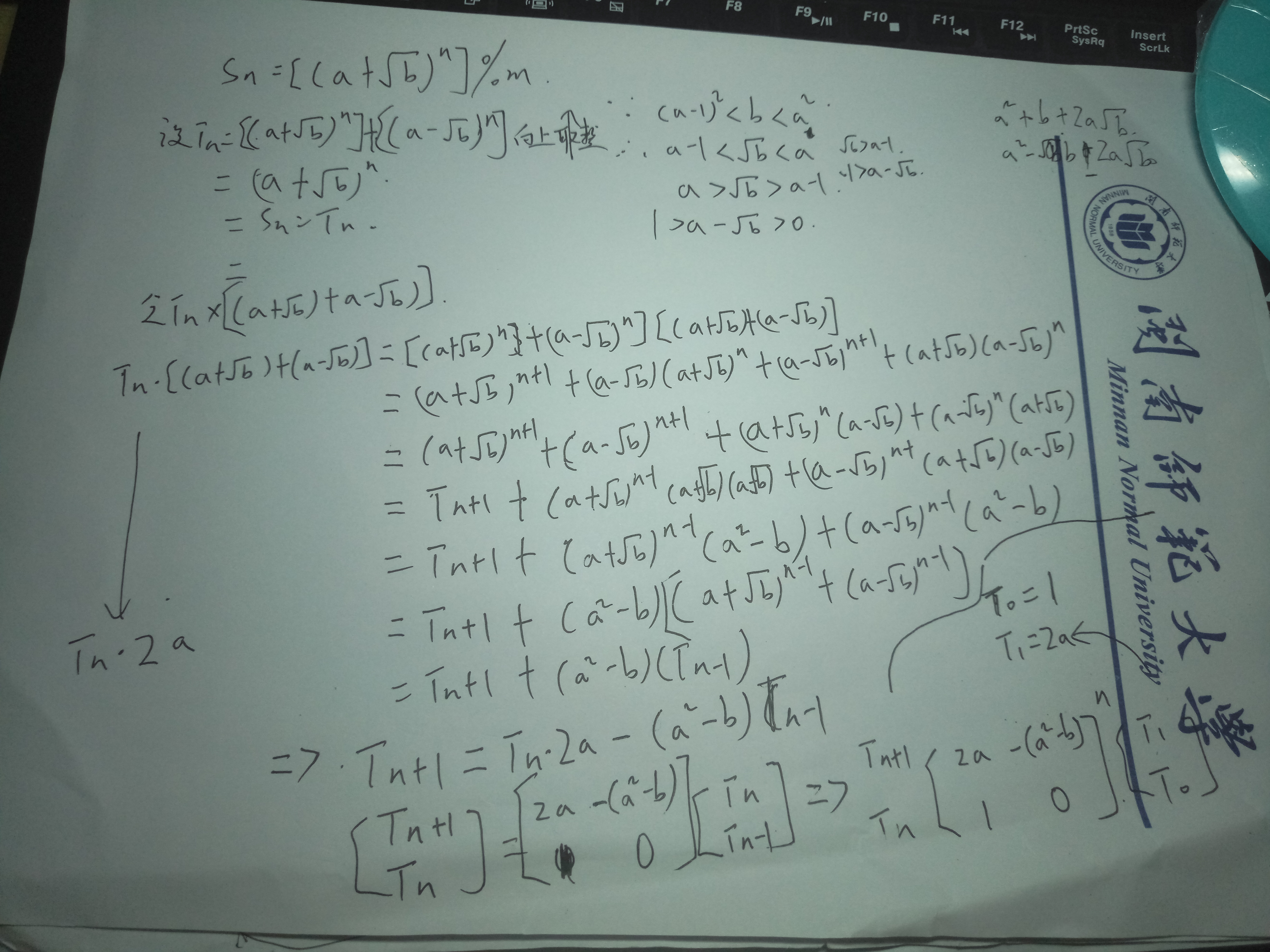
a,b,n,m都是整数,Sn向上取整 并且(a-1)^2<b<a^2
题解
1
2
3
4
5
6
7
8
9
10
11
12
13
14
15
16
17
18
19
20
21
22
23
24
25
26
27
28
29
30
31
32
33
34
35
36
37
38
39
40
41
42
43
#include <bits/stdc++.h> using namespace std ;typedef long long ll;#define pp pair<int,int> ll mod; const int maxn=1e6 +50 ;const ll inf=0x3f3f3f3f3f3f3f3f LL;int gcd (int a,int b) while (b){int t=a%b;a=b;b=t;}return a;}int lcm (int a,int b) return a*b/gcd(a,b);}typedef vector <ll>vec;typedef vector <vec>mat;mat mul (mat &A,mat &B) { mat C(A.size(),vec(B[0].size())); for (int i=0 ;i<A.size();i++) for (int k=0 ;k<B.size();k++) if (A[i][k]) for (int j=0 ;j<B[0 ].size();j++) C[i][j]=(C[i][j]+A[i][k]*B[k][j]%mod+mod)%mod; return C; } mat Pow (mat A,ll n) { mat B(A.size(),vec(A.size())); for (int i=0 ;i<A.size();i++)B[i][i]=1 ; for (;n;n>>=1 ,A=mul(A,A)) if (n&1 )B=mul(B,A); return B; } int main () std ::ios::sync_with_stdio(false ); std ::cin .tie(0 ); std ::cout .tie(0 ); ll a,b,n,m; while (cin >>a>>b>>n>>m){ mod=m; mat AA=mat(2 ,vec(2 )); AA[0 ][0 ]=2 *a;AA[0 ][1 ]=-(a*a-b); AA[1 ][0 ]=1 ;AA[1 ][1 ]=0 ; AA=Pow(AA,n); cout <<((((AA[1 ][0 ]*2 )%mod)*a)%mod+(AA[1 ][1 ]*2 )%mod+mod)%mod<<endl ; } return 0 ; }
题意
中文题
题解
直接做做不来的,列举几个情况
1
2
3
4
5
6
7
8
0 a
1 b
2 a*b
3 a*b^2
4 a^2*b^3
5 a^3*b^5
6 a^5*b^8
7 a^8*b^13
很容易看出a和b的项数各自符合斐波那契数列 然后可以用矩阵求出各自的项数,再用快速幂求出结果
注意因为这里的项数太大 所以要使用费马小定理/欧拉降幂
1
2
3
4
5
6
7
8
9
10
11
12
13
14
15
16
17
18
19
20
21
22
23
24
25
26
27
28
29
30
31
32
33
34
35
36
37
38
39
40
41
42
43
44
45
46
47
48
49
50
51
52
53
54
55
56
57
58
59
60
61
62
#include <bits/stdc++.h> using namespace std ;typedef long long ll;#define pp pair<int,int> const ll mod=1e9 +7 ;const int maxn=1e6 +50 ;const ll inf=0x3f3f3f3f3f3f3f3f LL;int gcd (int a,int b) while (b){int t=a%b;a=b;b=t;}return a;}int lcm (int a,int b) return a*b/gcd(a,b);}ll x,y; typedef vector <ll>vec;typedef vector <vec>mat;mat mul (mat& A,mat &B,ll mod) { mat C(A.size(),vec(B[0].size())); for (int i=0 ;i<A.size();i++) for (int k=0 ;k<B.size();k++) if (A[i][k]) for (int j=0 ;j<B[0 ].size();j++) C[i][j]=(C[i][j]+A[i][k]*B[k][j]%mod+mod)%mod; return C; } mat Pow (mat A,ll n) { mat B(A.size(),vec(A.size())); for (int i=0 ;i<A.size();i++)B[i][i]=1 ; for (;n;n>>=1 ,A=mul(A,A,mod-1 )) if (n&1 )B=mul(B,A,mod-1 ); return B; } ll pow_m (ll a,int n) { ll ret=1 ,tmp=a; while (n){ if (n&1 )ret=(ret*tmp)%mod; tmp=(tmp*tmp)%mod; n>>=1 ; } return ret; } int main () std ::ios::sync_with_stdio(false ); std ::cin .tie(0 ); std ::cout .tie(0 ); ll a,b,n; while (cin >>a>>b>>n){ mat A=mat(2 ,vec(2 )); A[0 ][0 ]=1 ;A[0 ][1 ]=1 ;A[1 ][0 ]=1 ;A[1 ][1 ]=0 ; if (n==0 ){cout <<a<<endl ;continue ;} if (n==1 ){cout <<b<<endl ;continue ;} mat B=Pow(A,n-2 ); ll aa=B[0 ][0 ]%(mod-1 ); aa=pow_m(a,aa); ll bb=(B[0 ][0 ]+B[0 ][1 ])%(mod-1 ); bb=pow_m(b,bb); cout <<(aa*bb)%mod<<endl ; } return 0 ; }
题意
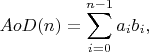
An Arc of Dream is a curve defined by following function:
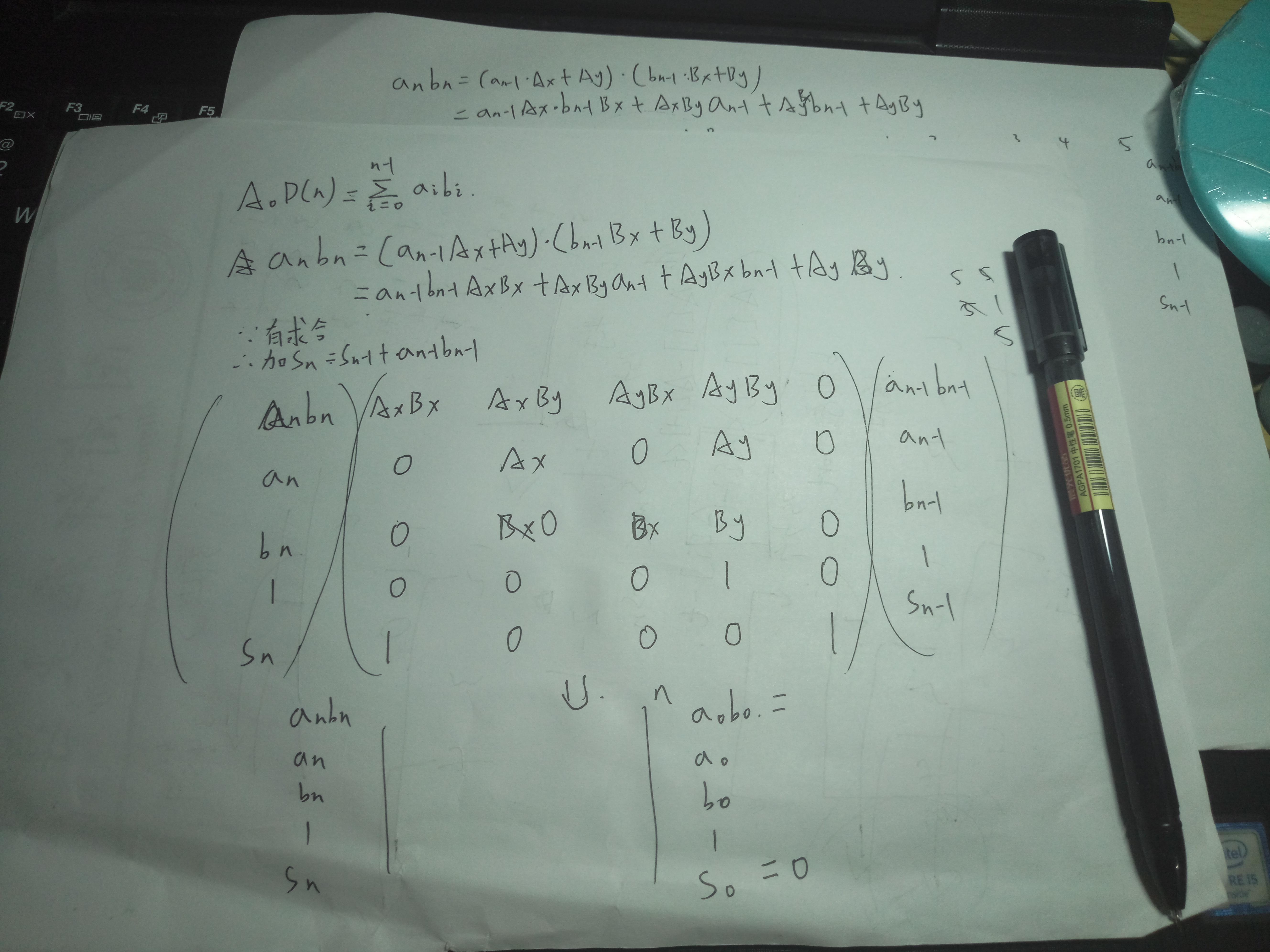
题意太好理解了就不解释了
题解
1
2
3
4
5
6
7
8
9
10
11
12
13
14
15
16
17
18
19
20
21
22
23
24
25
26
27
28
29
30
31
32
33
34
35
36
37
38
39
40
41
42
43
44
45
46
47
48
49
50
51
52
53
54
55
56
57
58
59
#include <bits/stdc++.h> using namespace std ;typedef long long ll;#define pp pair<int,int> const ll mod=1e9 +7 ;const int maxn=1e6 +50 ;const ll inf=0x3f3f3f3f3f3f3f3f LL;int gcd (int a,int b) while (b){int t=a%b;a=b;b=t;}return a;}int lcm (int a,int b) return a*b/gcd(a,b);}typedef vector <ll>vec;typedef vector <vec>mat;mat mul (mat &A,mat &B) { mat C(A.size(),vec(B[0].size())); for (int i=0 ;i<A.size();i++) for (int k=0 ;k<B.size();k++) if (A[i][k]) for (int j=0 ;j<B[0 ].size();j++) C[i][j]=(C[i][j]+A[i][k]*B[k][j]%mod+mod)%mod; return C; } mat Pow (mat A,ll n) { mat B(A.size(),vec(A.size())); for (int i=0 ;i<A.size();i++)B[i][i]=1 ; for (;n;n>>=1 ,A=mul(A,A)) if (n&1 )B=mul(B,A); return B; } int main () std ::ios::sync_with_stdio(false ); std ::cin .tie(0 ); std ::cout .tie(0 ); ll n,a0,AX,AY,b0,BX,BY; while (cin >>n){ cin >>a0>>AX>>AY; cin >>b0>>BX>>BY; a0%=mod;AX%=mod;AY%=mod; b0%=mod;BX%=mod;BY%=mod; mat a=mat(5 ,vec(5 )); a[0 ][0 ]=AX*BX%mod;a[0 ][1 ]=AX*BY%mod;a[0 ][2 ]=AY*BX%mod;a[0 ][3 ]=AY*BY%mod;a[0 ][4 ]=0 ; a[1 ][0 ]=0 ;a[1 ][1 ]=AX%mod;a[1 ][2 ]=0 ;a[1 ][3 ]=AY%mod;a[1 ][4 ]=0 ; a[2 ][0 ]=0 ;a[2 ][1 ]=0 ;a[2 ][2 ]=BX%mod;a[2 ][3 ]=BY%mod;a[2 ][4 ]=0 ; a[3 ][0 ]=0 ;a[3 ][1 ]=0 ;a[3 ][2 ]=0 ;a[3 ][3 ]=1 ;a[3 ][4 ]=0 ; a[4 ][0 ]=1 ;a[4 ][1 ]=0 ;a[4 ][2 ]=0 ;a[4 ][3 ]=0 ;a[4 ][4 ]=1 ; a=Pow(a,n); mat b=mat(5 ,vec(1 )); b[0 ][0 ]=a0*b0%mod;b[1 ][0 ]=a0%mod;b[2 ][0 ]=b0%mod;b[3 ][0 ]=1 ;b[4 ][0 ]=0 ; b=mul(a,b); cout <<b[4 ][0 ]<<endl ; } return 0 ; }






近期评论