
Lucas’s theorem
Click(chuo1) me(wo3) for more info:
Just take a look of this theorem:
$binom{m}{n} equiv Pi_{i=0}^{k} binom{m_{i}}{n_{i}}$(mod p),
where $m = m_{k}p^{k} + m_{k-1}p^{k-1}+ldots + m_{1}p + m_{0}$ and $n = n_{k}p^{k} + n_{k-1}p^{k-1}+ldots + n_{1}p + n_{0}$ are the base p expansions of m and n. This uses the convention that $binom{m}{n} =0$ when $m < n$.
Hockey stick identity
Click(chuo1) me(wo3) for more info:
** Theorem: For whole numbers n and r (n $geq$ > r), $sum_{k=r}^{n} binom{k}{r} = binom{n+1}{r+1}$ **
The hockey stick identity gets its name by how it is represented in Pascal’s triangle.
In Pascal’s triangle, the sum of the elements in a diagonal line starting with is equal to the next element down diagonally in the opposite direction. Circling these elements creates a “hockey stick” shape: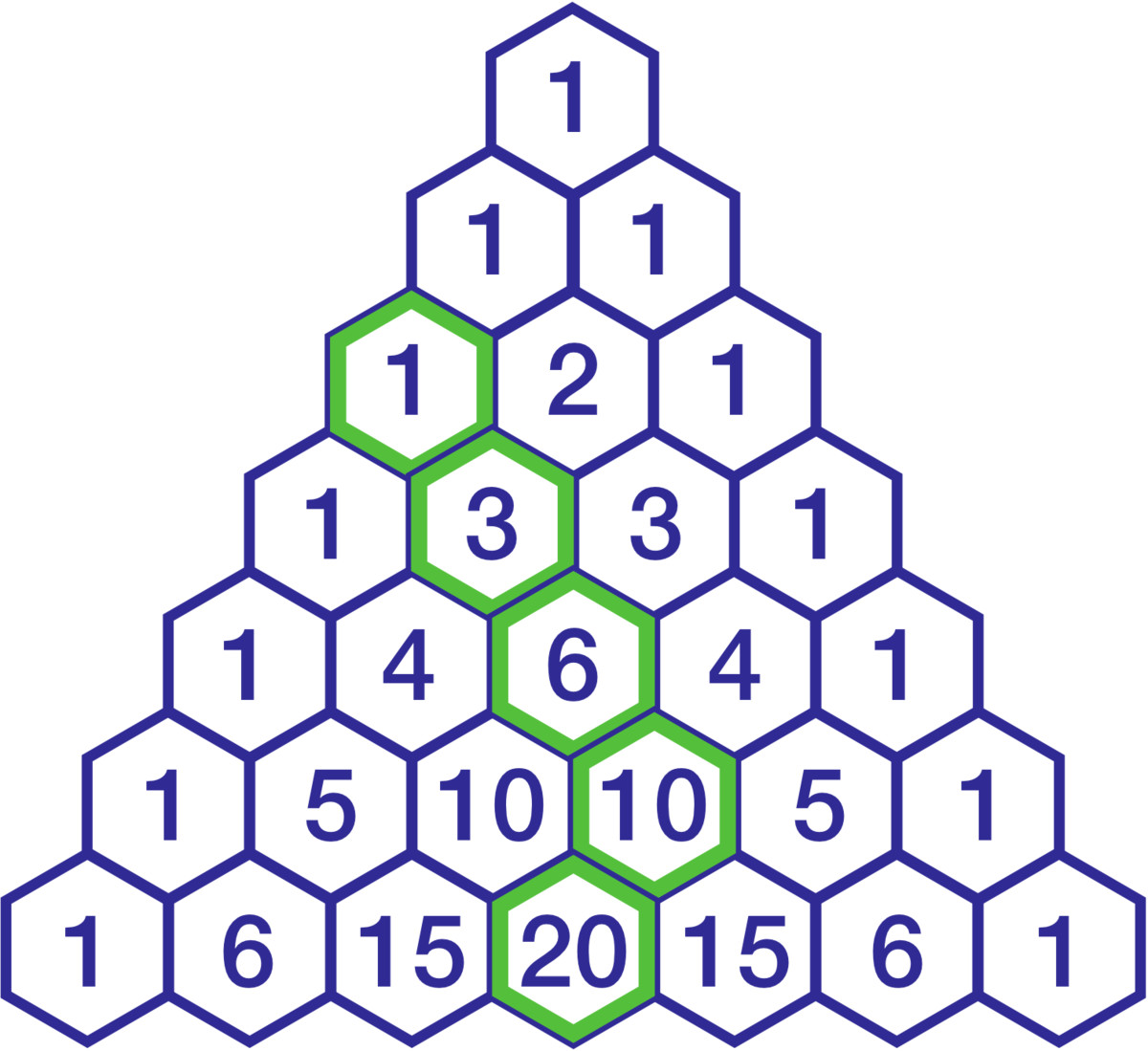
Vandermonde’s identity
Click(chuo1) me(wo3) for more info:
The theorem states that any combination of k objects from a group of (m+n) objects must have some objects from a group of m objects and the remaining (k-r) objects from a group of n.
$ binom{m+n}{k} = sum_{r=0}^{k} binom{m}{r}binom{n}{k-r} $
Faulhaber’s formula
Click(chuo1) me(wo3) for more info:
$sum_{k=1}^{n}k = frac{n(n+1)}{2}$
$sum_{k=1}^{n}k^{2} = frac{n(n+1)(2n+1)}{6}$
$sum_{k=1}^{n}k^{3} = frac{n^{2}(n+1)^{2}}{4}$
The theorem provides a generalized formula to compute sums $sum_{k=1}^{n} k^{a}$.
$sum_{k=1}{n} k^{a} = frac{1}{a+1} sum_{j=0}^{a}(-1)^{j} binom{a+1}{j}B_{j}n^{a+1-j}$.
Here $B_{j}$ is the j-th Bernoulli number.




近期评论