/** * Register, escalate, and configure the AspectJ auto proxy creator based on the value * of the @{@link EnableAspectJAutoProxy#proxyTargetClass()} attribute on the importing * {@code@Configuration} class. */ @Override publicvoidregisterBeanDefinitions( AnnotationMetadata importingClassMetadata, BeanDefinitionRegistry registry){ //将AnnotationAwareAspectJAutoProxyCreator类封装成RootBeanDefinition并注册 AopConfigUtils.registerAspectJAnnotationAutoProxyCreatorIfNecessary(registry);
AnnotationAttributes enableAspectJAutoProxy = AnnotationConfigUtils.attributesFor(importingClassMetadata, EnableAspectJAutoProxy.class); if (enableAspectJAutoProxy != null) { if (enableAspectJAutoProxy.getBoolean("proxyTargetClass")) { AopConfigUtils.forceAutoProxyCreatorToUseClassProxying(registry); } if (enableAspectJAutoProxy.getBoolean("exposeProxy")) { AopConfigUtils.forceAutoProxyCreatorToExposeProxy(registry); } } }
if (!StringUtils.hasLength(beanName) || !this.targetSourcedBeans.contains(beanName)) { if (this.advisedBeans.containsKey(cacheKey)) { returnnull; } if (isInfrastructureClass(beanClass) || shouldSkip(beanClass, beanName)) { this.advisedBeans.put(cacheKey, Boolean.FALSE); returnnull; } }
// Create proxy here if we have a custom TargetSource. // Suppresses unnecessary default instantiation of the target bean: // The TargetSource will handle target instances in a custom fashion. TargetSource targetSource = getCustomTargetSource(beanClass, beanName); if (targetSource != null) { if (StringUtils.hasLength(beanName)) { this.targetSourcedBeans.add(beanName); } Object[] specificInterceptors = getAdvicesAndAdvisorsForBean(beanClass, beanName, targetSource); Object proxy = createProxy(beanClass, beanName, specificInterceptors, targetSource); this.proxyTypes.put(cacheKey, proxy.getClass()); return proxy; }
/** * Find all eligible Advisors for auto-proxying this class. * @param beanClass the clazz to find advisors for * @param beanName the name of the currently proxied bean * @return the empty List, not {@code null}, * if there are no pointcuts or interceptors * @see #findCandidateAdvisors * @see #sortAdvisors * @see #extendAdvisors */ protected List<Advisor> findEligibleAdvisors(Class<?> beanClass, String beanName){ //获取候选增强器提供者 List<Advisor> candidateAdvisors = findCandidateAdvisors(); //验证有效性. 也就是canApply 可以应用的. List<Advisor> eligibleAdvisors = findAdvisorsThatCanApply(candidateAdvisors, beanClass, beanName); // 钩子方法方便拓展 extendAdvisors(eligibleAdvisors); if (!eligibleAdvisors.isEmpty()) { //排序 eligibleAdvisors = sortAdvisors(eligibleAdvisors); } return eligibleAdvisors; } //AnnotationAwareAspectJAutoProxyCreator类findCandidateAdvisors()方法 @Override protected List<Advisor> findCandidateAdvisors(){ // Add all the Spring advisors found according to superclass rules. AbstractAdvisorAutoProxyCreator#findCandidateAdvisors // 根据超类的方式(Advisor) 获取Spring的增强器 List<Advisor> advisors = super.findCandidateAdvisors(); // Build Advisors for all AspectJ aspects in the bean factory. // 为bean工厂中的所有AspectJ方面 构建增强器 if (this.aspectJAdvisorsBuilder != null) { // 这里获取 advisors.addAll(this.aspectJAdvisorsBuilder.buildAspectJAdvisors()); } return advisors; }
/** *AbstractAdvisorAutoProxyCreator类findCandidateAdvisors * Find all candidate Advisors to use in auto-proxying. * @return the List of candidate Advisors */ protected List<Advisor> findCandidateAdvisors(){ Assert.state(this.advisorRetrievalHelper != null, "No BeanFactoryAdvisorRetrievalHelper available"); returnthis.advisorRetrievalHelper.findAdvisorBeans(); }
//AbstractAdvisorAutoProxyCreator类的findAdvisorBeans() public List<Advisor> findAdvisorBeans(){ // Determine list of advisor bean names, if not cached already. String[] advisorNames = this.cachedAdvisorBeanNames; if (advisorNames == null) { // Do not initialize FactoryBeans here: We need to leave all regular beans // uninitialized to let the auto-proxy creator apply to them! //在beanFactory中 找到类型为Advisor的类. 也就是实现了Advisor的类. 这里拿到的都是advisor类的名字 advisorNames = BeanFactoryUtils.beanNamesForTypeIncludingAncestors( this.beanFactory, Advisor.class, true, false); this.cachedAdvisorBeanNames = advisorNames; } if (advisorNames.length == 0) { returnnew ArrayList<>(); }
List<Advisor> advisors = new ArrayList<>(); for (String name : advisorNames) { if (isEligibleBean(name)) { // 如果这个bean 正在被创建. 就跳过了. if (this.beanFactory.isCurrentlyInCreation(name)) { if (logger.isTraceEnabled()) { logger.trace("Skipping currently created advisor '" + name + "'"); } } else { try { //将这些类初始化. advisors.add(this.beanFactory.getBean(name, Advisor.class)); } catch (BeanCreationException ex) { Throwable rootCause = ex.getMostSpecificCause(); if (rootCause instanceof BeanCurrentlyInCreationException) { BeanCreationException bce = (BeanCreationException) rootCause; String bceBeanName = bce.getBeanName(); if (bceBeanName != null && this.beanFactory.isCurrentlyInCreation(bceBeanName)) { if (logger.isTraceEnabled()) { logger.trace("Skipping advisor '" + name + "' with dependency on currently created bean: " + ex.getMessage()); } // Ignore: indicates a reference back to the bean we're trying to advise. // We want to find advisors other than the currently created bean itself. continue; } } throw ex; } } } } return advisors; }
/** * Determine whether the aspect bean with the given name is eligible. * <p>The default implementation always returns {@code true}. * @param beanName the name of the aspect bean * @return whether the bean is eligible */ protectedbooleanisEligibleBean(String beanName){ returntrue; }
@Override public Object getProxy(@Nullable ClassLoader classLoader){ if (logger.isTraceEnabled()) { logger.trace("Creating CGLIB proxy: " + this.advised.getTargetSource()); }
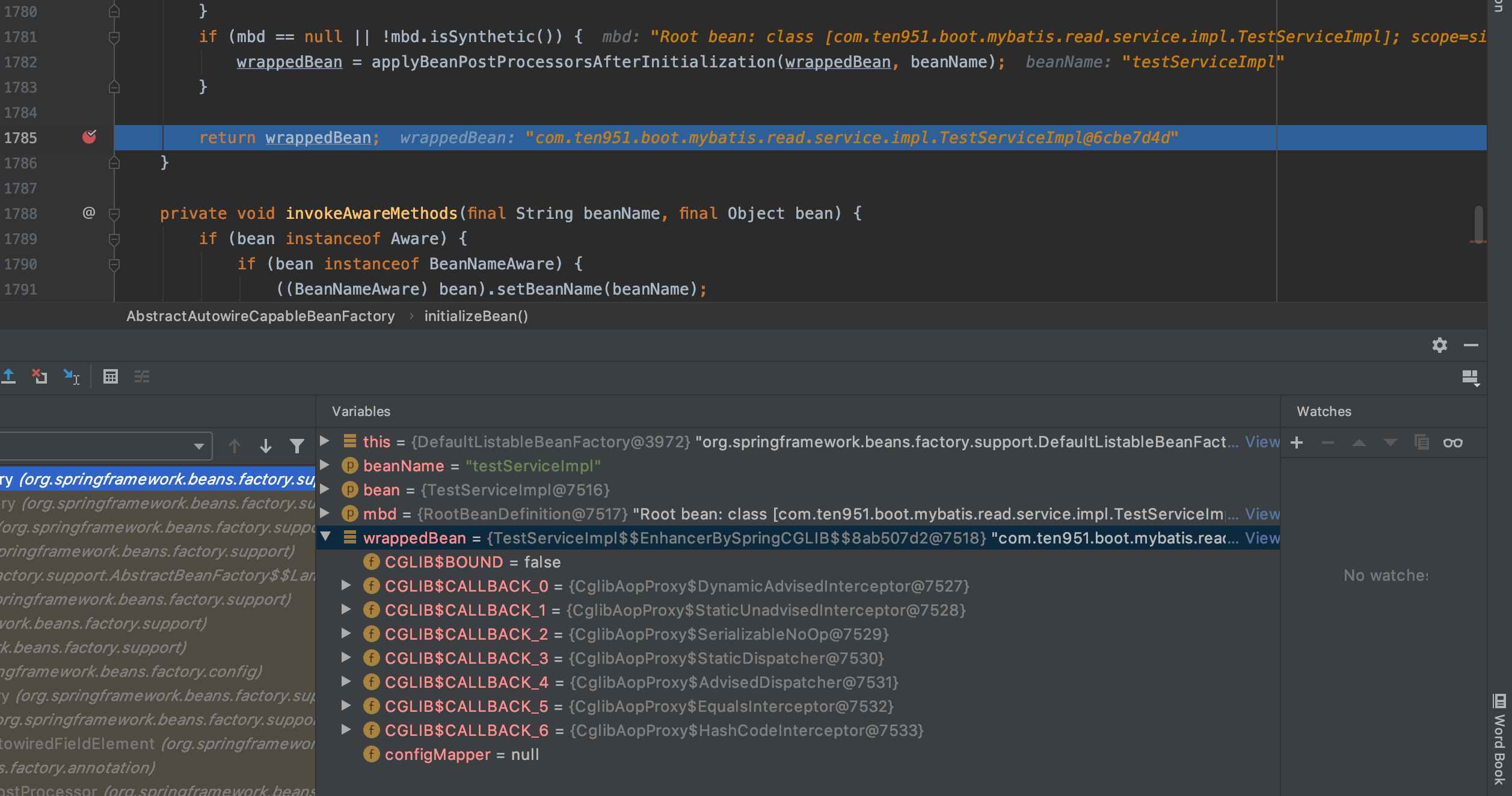
try { // advised是AProxyCreatorSupport类. 获取目标类 需要被代理的类 也是上图中 TestServiceImpl Class<?> rootClass = this.advised.getTargetClass(); Assert.state(rootClass != null, "Target class must be available for creating a CGLIB proxy");
// Validate the class, writing log messages as necessary. //必要的验证 比如不能是final的 validateClassIfNecessary(proxySuperClass, classLoader);
// Configure CGLIB Enhancer... Enhancer enhancer = createEnhancer(); if (classLoader != null) { enhancer.setClassLoader(classLoader); if (classLoader instanceof SmartClassLoader && ((SmartClassLoader) classLoader).isClassReloadable(proxySuperClass)) { enhancer.setUseCache(false); } } //设置被代理类 enhancer.setSuperclass(proxySuperClass); enhancer.setInterfaces(AopProxyUtils.completeProxiedInterfaces(this.advised)); // 代理类名称生成策略 enhancer.setNamingPolicy(SpringNamingPolicy.INSTANCE); enhancer.setStrategy(new ClassLoaderAwareUndeclaredThrowableStrategy(classLoader)); // 获取所有回调 Callback[] callbacks = getCallbacks(rootClass); Class<?>[] types = new Class<?>[callbacks.length]; for (int x = 0; x < types.length; x++) { types[x] = callbacks[x].getClass(); } // fixedInterceptorMap only populated at this point, after getCallbacks call above enhancer.setCallbackFilter(new ProxyCallbackFilter( this.advised.getConfigurationOnlyCopy(), this.fixedInterceptorMap, this.fixedInterceptorOffset)); enhancer.setCallbackTypes(types);
// Generate the proxy class and create a proxy instance. return createProxyClassAndInstance(enhancer, callbacks); } catch (CodeGenerationException | IllegalArgumentException ex) { thrownew AopConfigException("Could not generate CGLIB subclass of " + this.advised.getTargetClass() + ": Common causes of this problem include using a final class or a non-visible class", ex); } catch (Throwable ex) { // TargetSource.getTarget() failed thrownew AopConfigException("Unexpected AOP exception", ex); } }
// Choose an "aop" interceptor (used for AOP calls). Callback aopInterceptor = new DynamicAdvisedInterceptor(this.advised);
// Choose a "straight to target" interceptor. (used for calls that are // unadvised but can return this). May be required to expose the proxy. Callback targetInterceptor; if (exposeProxy) { targetInterceptor = (isStatic ? new StaticUnadvisedExposedInterceptor(this.advised.getTargetSource().getTarget()) : new DynamicUnadvisedExposedInterceptor(this.advised.getTargetSource())); } else { targetInterceptor = (isStatic ? new StaticUnadvisedInterceptor(this.advised.getTargetSource().getTarget()) : new DynamicUnadvisedInterceptor(this.advised.getTargetSource())); }
// Choose a "direct to target" dispatcher (used for // unadvised calls to static targets that cannot return this). Callback targetDispatcher = (isStatic ? new StaticDispatcher(this.advised.getTargetSource().getTarget()) : new SerializableNoOp()); // 这里设置拦截器的顺序和上边图片上的顺序是一致的. Callback[] mainCallbacks = new Callback[] { aopInterceptor, // for normal advice targetInterceptor, // invoke target without considering advice, if optimized new SerializableNoOp(), // no override for methods mapped to this targetDispatcher, this.advisedDispatcher, new EqualsInterceptor(this.advised), new HashCodeInterceptor(this.advised) };
Callback[] callbacks;
// If the target is a static one and the advice chain is frozen, // then we can make some optimizations by sending the AOP calls // direct to the target using the fixed chain for that method. if (isStatic && isFrozen) { Method[] methods = rootClass.getMethods(); Callback[] fixedCallbacks = new Callback[methods.length]; this.fixedInterceptorMap = new HashMap<>(methods.length);
// TODO: small memory optimization here (can skip creation for methods with no advice) for (int x = 0; x < methods.length; x++) { List<Object> chain = this.advised.getInterceptorsAndDynamicInterceptionAdvice(methods[x], rootClass); fixedCallbacks[x] = new FixedChainStaticTargetInterceptor( chain, this.advised.getTargetSource().getTarget(), this.advised.getTargetClass()); this.fixedInterceptorMap.put(methods[x].toString(), x); }
// Now copy both the callbacks from mainCallbacks // and fixedCallbacks into the callbacks array. callbacks = new Callback[mainCallbacks.length + fixedCallbacks.length]; System.arraycopy(mainCallbacks, 0, callbacks, 0, mainCallbacks.length); System.arraycopy(fixedCallbacks, 0, callbacks, mainCallbacks.length, fixedCallbacks.length); this.fixedInterceptorOffset = mainCallbacks.length; } else { callbacks = mainCallbacks; } return callbacks; }




近期评论