bfs

Assumption

All vertices are reachable from the given vertex. We use the following graph.
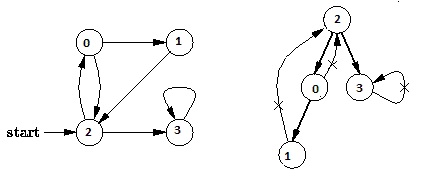
graph

Instruction

  • Construct a directed graph class with adjacency list representation.
  • Use a list to record states of all vertices with True for visited and False for unvisited.
  • Use a queue to store vertices to start in each inner loop.
  • Start from one given vertex to reach all vertices reachable.
  • When a vertex is reached, alter the corresponding element in the state list from False to True.
  • When the queue is empty, all vertices are reached.

Code in Python 3.5

1
2
3
4
5
6
7
8
9
10
11
12
13
14
15
16
17
18
19
20
21
22
23
24
25
26
27
28
29
30
31
32
33
34
35
36
37
38
39
40
41
42
43
44
45
46
47
48
49
50
51
52
53
54
55
56
from collections import defaultdict, deque


class :
'''
A class for directed graph, with a method BFS to do Broad First Search and a method addEdge to construct adjacency list.
'''

def __init__(self):

self.graph = defaultdict(list)

def __repr__(self):
# function to demonstrate the adjacency list of the graph
a_list = ''
for k,v in self.graph.items():
a_list += repr(k) + ': ' + repr(v) + 'n'
return a_list

def addEdge(self, l, r):
# construct the adjacency list, add an edge to the graph
self.graph[l].append(r)

def BFS(self, start):
# conduct BFS with a given start vertex and print it out
visited = [False] * len(self.graph)
queue = deque([])
queue.append(start)
visited[start] = True

while queue:
start = queue.popleft()
for i in self.graph[start]:
if visited[i] is False:
queue.append(i)
visited[i] = True
if queue:
print(start, end='=>')
else:
print(start)


if __name__ == '__main__':
# create a graph given in the above diagram
graph = Graph()
graph.addEdge(0, 1)
graph.addEdge(0, 2)
graph.addEdge(1, 2)
graph.addEdge(2, 0)
graph.addEdge(2, 3)
graph.addEdge(3, 3)
# print the adjacency list
print('the adjacency list of this graph: ')
print(graph)
print('BFS result with vertex 2 as start point:')
graph.BFS(2)

Output

1
2
3
4
5
6
7
the adjacency list of this graph: 
0: [1, 2]
1: [2]
2: [0, 3]
3: [3]

2=>0=>3=>1

Reference



